Six years ago, your blog mistress's husband starting experimenting with growing culinary herbs hydroponically. Four years ago, I started actively helping with the hydroponics. I even interned in a local commercial hydroponic farm so I could understand hydroponics better. There's lots of fun science involved with growing hydroponic plants! Our hydroponic system, designed and built by my husband, is inside our house, in a room right off the kitchen:

Since the system is inside, without access to sufficient natural light, we light our plants with two 2 foot x 4 foot fluorescent lights, each of which holds 8 bulbs. There's many different aspects of light relevant to growing plants: the amount of light falling on a plant (inverse square law), the heat generated by the bulbs, the wavelength of the light, and the color temperature of the light. This article focuses on the color temperature of the light.
When we learn about light, and color associated with light, we usually learn about wavelength. Light is electromagnetic radiation, transmitted by the sun as an oscillating wave. Wavelength measures the distance between two adjacent peaks. Only a small portion of electromagnetic radiation is visible to the human eye. If we pass the visible wavelengths of light through a prism, the prism separates the light into multiple wavelengths, each with a visible color, forming a rainbow.

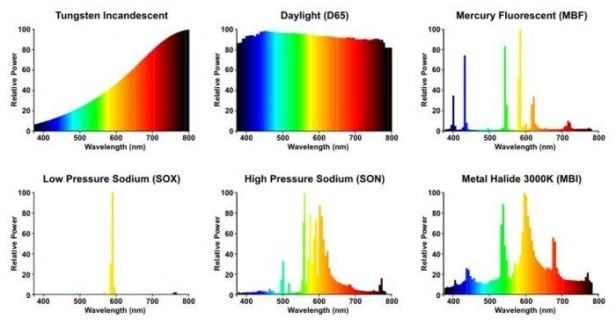
Theoretically, white light consists of equal quantities of all wavelengths of visible light. However, artificial lighting (even if it appears white) does not. Color temperature is the surface temperature in kelvin of the electromagnetic radiation emitted from an ideal black body. In plainer language, any object will emit light if it is heated to a high enough temperature and the color of the light will change as the temperature of the object increases. The color of the light changes because the body emitting the light throws out more radiation in some wavelengths of the visible range. The light still appears white to the human eye because it hasn't been split into all its different wavelengths, but the light might appear to have a bluish cast or a reddish cast because there's more radiation in the blue or red spectrum, as illustrated in the following image comparing the spectrum emitted by various types of lightbulbs.
As crafters, we are thinking about color temperature when we take our skein of yarn outside to look at it in daylight, rather than under the yellowish cast of our household incandescent light. When photographers 'white balance' their cameras before taking a picture, they are manipulating the color temperature of light in order to get a truer representation of the colors they see with the naked eye.
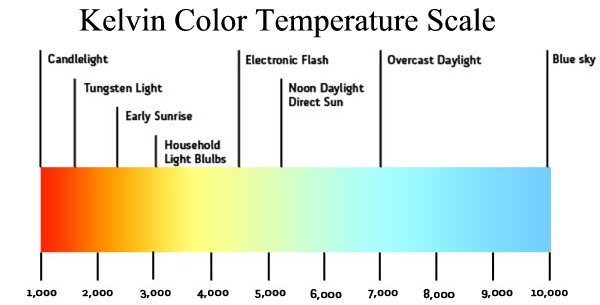
Color temperature matters to plants too. Since so many plants are grown commercially in hydroponic systems, a great deal of research has been done to determine the best lighting scenarios for plants in various stages of life. In general, cool spectrum lights (6500 K, which has a bluish cast) support initial growth and leafing while warm spectrum lights (3000 K, which has a reddish cast) support flowering, fruit production, and stem development.
When the Greene household first started with hydroponics, we only had 6500 K bulbs. We grow culinary herbs and lettuces. We don't want to encourage flowering and fruit production; we want to encourage greenery. Earlier this year, we decided to add a few 3000 K bulbs to our hydroponic system to see if it made a difference in production. Since the goal of all plants is to reproduce by producing seeds, we thought a little red spectrum might encourage a plant to grow more quickly towards its goal. We replaced two bulbs in each of our lamps with 3000 K bulbs, leaving the other six bulbs in each lamp as 6500 K bulbs.
Any production increases have been minor or are muddied due to changes in nutrients that we made at the same time as the bulb changes. We noticed a very interesting thing, however. One of our red varieties of lettuce changed color in a major way!
We started growing Outredgeous lettuce a couple years ago because NASA was growing it on ISS and my husband is a major space geek. (You may have heard that in August 2015 astronauts were allowed to eat plants grown on ISS for the first time. The crop they ate was Outredgeous lettuce.) We like the variety and keep it in regular rotation in our hydroponic system.
Outredgeous is a red variety; we always got green leaves with red speckles. Then we added the red bulbs to the system. The Outredgeous lettuce quickly turned a deep burgundy color, wherever the leaves were exposed to the light. Portions of the leaf that did not get exposed to the light remained green and many of the leaves have a distinct line across them, with the upper portion burgundy and the lower portion green.
Recently, we transplanted Outredgeous seedlings from the seed starter (only 6500K bulbs) to the main hydroponic system. Within a few days, the seedlings turned from all green to all red. When we transplanted another batch of seedlings the following week, I thought it would be interesting to see just how quickly the green to red change happens, so I took a time lapse video to document the change.
The seedlings we transplanted previously are the larger red lettuce plants on the left. The new seedlings are in the row immediately to the right of those plants (the one seedling in the very back of this row is sage, not Outredgeous lettuce), behind the "Outredgeous 9-19-15" label.
TRIGGER WARNING: Flickering Lights. Fluorescent lights plus time lapse = flicker because the frame rate of the pictures is different than the rate at which the lights flicker. I did a great deal of post production and removed the majority of the flicker; it's probably at 15% of the level it was before. Unfortunately, I wasn't able to remove all of it. Before I did the post-production work, watching the video back triggered a headache for me. After post-production, I can watch it without triggering a headache. YMMV.
For this time-lapse video, I set the iPad to take 1 picture every minute. The pictures are played back at 30 frames / second, so an hour of real life equals 2 seconds of video. The previous set of plants changed color in two days. The new seedlings did not change as fast or as dramatically as the last set did. It's likely that the taking of the video increased the amount of time it takes for the plants to change color. The side of the hydroponic system is lined with Mylar. The shiny mylar bounces light back onto the plants, increasing total light exposure. I had to remove that side in order to set up the iPad (see the picture of the system at the top of the post), thereby decreasing the amount of light the plants usually receive. In addition, this week's seedlings were smaller at the time of transplant than the previous set were. The seedlings probably need to reach some minimum size before the color pigments are activated.
On Wednesday, five days after the completion of the video, the seedlings are larger and redder than before! They are on the left now because the older lettuce was getting big enough to shade the smaller seedlings, so we moved the small ones over where they would get plenty of light.

So what's happening here? The red coloration of the lettuce comes from Anthocyanin pigments. These pigments are responsible for red, purple, and black colors in a wide variety of plants, e.g. blueberries, eggplant peel, blackberries, red raspberries. This family of pigments is also the source of red colors in fall leaves.

Anthocyanin pigments respond to the color temperature of the light. In the case of our Outredgeous lettuce, 25% red light causes a significant response in a relatively short period of time!
Other red lettuces also respond to color temperature changes, but not as quickly or in as dramatic a fashion. While doing a little research for this blog post, I came across an article on finishing red lettuces in commercial production. The commercial producers want to grow all their crops under the same white lights, but want red lettuces that look beautiful for consumers. The goal of the experiment was to find the minimum time a mature plant required to turn fully red so the plants could be grown under white lights and then finished with a few days under different lighting conditions to increase the red pigmentation. The researchers grew four varieties of red lettuces (but not Outredgeous) under white light, then moved them to different lighting scenarios to see what would happen. Here's their picture depicting the results for one variety.
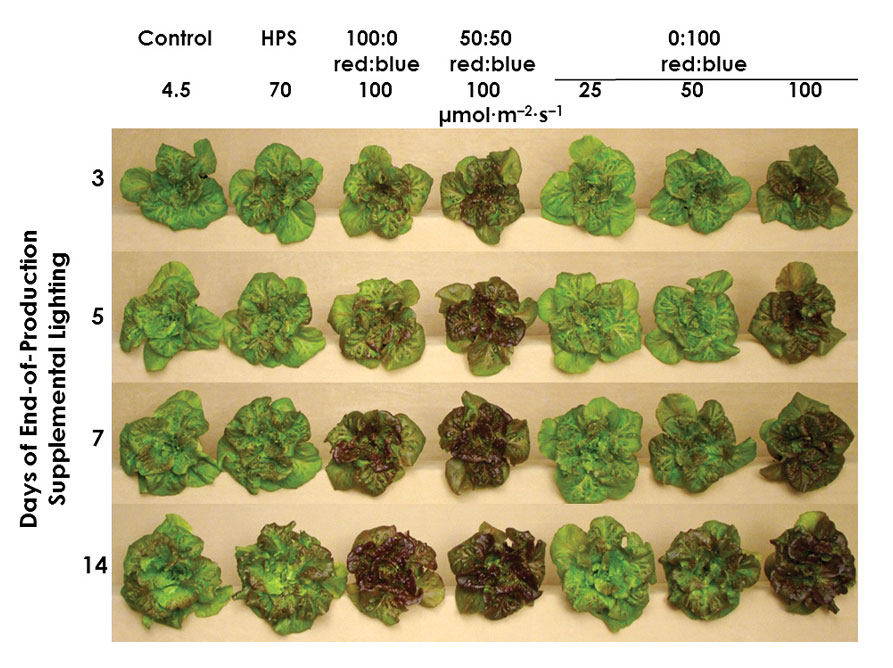
The lettuce variety depicted here does not respond to only 25% red light in the same manner as our Outredgeous lettuce does. (I should note here that the lights used in the commercial experiment were LEDs while we use fluorescents. We'd prefer to use LEDs due to their massive energy savings, but have not yet found reliable, reasonably-priced consumer-level LEDs in the appropriate color temperatures and sizes needed for hydroponics.) I found it interesting that the 100:0 and 0:100 had a similar color-change. I did not expect this result, so did a little research to see if I could find out why this would happen. It turns out that one function of Anthocyanin pigments is to protect the plant from light stress when there's too much light. A high concentration of blue light triggers this light-stress response in the plants, resulting in increased Anthocyanin concentrations. I'm not sure why we did not see that same response when we grew the Outredgeous under only blue light. It may be that the Outredgeous lettuce contains a different Anthocyanin pigment than any of the varieties included in the experiment, and that pigment responds primarily to red light.
I hope you enjoyed this peek into one of the considerations of growing hydroponic plants. I've learned a great deal of fun science through hydroponics. Plants are pretty awesome :-)